CASE FILE: GN-2026-PILATE-RING
STATUS: AUTHENTIC ARTIFACT / OWNERSHIP UNPROVEN
LOCATION: Herodium, southeast of Jerusalem and Bethlehem
FILE UPDATED: September 10, 2026
The ring was never gold.
It was not set with a gemstone or recovered from a box marked Property of Pontius Pilate. It was a modest copper-alloy object pulled from ancient debris at Herodium during excavations in 1968–1969.
For decades, it attracted little attention. Then cleaning and imaging exposed six Greek letters around the image of a vessel:
ΠΙΛΑΤΟ — PILATO
The name was difficult to ignore. Pontius Pilate governed Judea during the period in which the Gospels place the Roman trial and crucifixion of Jesus.
The headlines practically wrote themselves: Pontius Pilate’s ring discovered.
But one missing—or unexpected—letter may be the most revealing part of the entire artifact.
Did archaeologists find Pontius Pilate’s personal ring?
Direct answer: No one has established that the ring was personally owned or worn by Pontius Pilate.
The inscription probably connects the object with the name Pilate, and its archaeological context makes an association with the prefect’s administration plausible. Its inexpensive manufacture, unusual spelling and grammatical form, however, argue against identifying it as Pilate’s personal signet ring.
Catherine E. Bonesho’s 2026 peer-reviewed study proposes that PILATO is a Greek-letter transliteration of the Latin dative form Pilato. Under that interpretation, the impression may have identified something intended “for Pilate” or associated with his administration.
The wearer may have been a local worker—possibly enslaved or formerly enslaved—performing routine duties within Pilate’s administrative network. That reconstruction is plausible, not proven.
The new verdict is subtler than “Pilate wore this.” It may also be historically more interesting.

Evidence Item 01: Where the ring was found
Archaeologist Gideon Foerster’s team excavated the ring at Herodium during the 1968–1969 season. Herodium is the fortified palace complex constructed by Herod the Great southeast of Jerusalem and Bethlehem.
The ring reportedly came from an archaeological deposit containing numerous objects. It was not found in a securely identified room belonging to Pontius Pilate. That limits what its location can establish.
Herodium was nevertheless an important royal and administrative complex. A functional object connected with Roman government business would not be out of place there. Location makes a connection plausible without identifying the person who wore it.
Evidence Item 02: What is actually engraved on it?
The ring’s bezel contains an image generally identified as a krater, a vessel used for mixing wine and water. Around that image are Greek letters divided by the vessel:
ΠΙ | ΛΑΤΟ
Read together, they produce PILATO.
The inscription matters because Pilatus was an uncommon name in the region. The combination of the name, approximate period and administrative setting immediately raised the possibility of Pontius Pilate.
But identifying letters is not the same as identifying an owner. The key question is grammatical: What was the inscription intended to communicate when the ring was pressed into another material?
Evidence Item 03: The missing ending
If the inscription simply named Pilate in Greek, one would expect a form such as PILATOS. If it meant “belonging to Pilate,” a Greek genitive form such as PILATOU would be more natural. Earlier interpretations sometimes treated PILATO as an abbreviated, defective or incomplete Greek form.
Bonesho argues that the final omicron—the O in PILATO—should not automatically be treated as an error. It may instead preserve the Latin dative PILATO, written with Greek characters.
Latin and Greek regularly crossed paths in Roman Judea. Roman officials represented an empire whose formal language was Latin, while Greek was widely used in administration, commerce and everyday communication throughout the eastern Mediterranean.
The strange spelling may not be a mistake. It may preserve two linguistic worlds meeting inside one government operation.
Evidence Item 04: A ring for work, not status
The object is made from copper alloy and has been described as comparatively crude. It does not resemble the prestigious personal jewelry normally associated with a Roman prefect.
That does not make it insignificant. Administrative systems depend on ordinary objects: labels, seals, containers, documents and the people assigned to handle them. A working ring could have stamped clay, wax or other materials connected with official business.
Bonesho proposes that local elites may have commissioned the ring for an enslaved or formerly enslaved worker conducting tasks associated with Pilate’s administration. No surviving record identifies the wearer, so the person’s exact identity and status remain unknown.
But the administrative interpretation explains several clues together:
- The inexpensive material
- The practical construction
- The name PILATO
- The possible Latin grammatical form
- The Greek lettering
- The ring’s archaeological setting at Herodium
The object may not have been a governor’s luxury possession. It may have been equipment used by an unnamed person working beneath him.
Evidence Item 05: The disagreement did not begin in 2026
The ring was formally published in 2018 by Shua Amorai-Stark and colleagues after laboratory cleaning and photography clarified the inscription. The researchers considered an association with Pontius Pilate possible while acknowledging uncertainty about personal ownership.
In 2023, Roman historians Werner Eck and Avner Ecker published an article pointedly titled Not a “Signet Ring” of Pontius Pilatus. Their study challenged the popular presentation of the object as Pilate’s personal ring.
Bonesho’s 2026 paper enters an existing scholarly debate and offers a more specific linguistic explanation for the unusual ending. It does not suddenly expose the artifact as a fake or overturn a settled consensus.
The ring is real. The inscription is real. The debate concerns what the letters mean, what the object did and who probably used it.
Evidence Item 06: The Pilate Stone is the stronger identification
The Herodium ring is not the primary reason historians accept Pontius Pilate as a historical Roman official.
In 1961, archaeologists at Caesarea Maritima discovered a damaged Latin dedicatory inscription naming Pontius Pilatus and identifying him as prefect of Judea. Known as the Pilate Stone, it remains the clearest archaeological inscription directly naming him.

Ancient literary sources also discuss Pilate, including the Jewish writers Josephus and Philo and the Roman historian Tacitus. The Gospels therefore do not introduce Pilate as a person otherwise unknown to history.
The ring could add texture to that record by illuminating his administration. It is not needed to rescue Pilate from nonexistence.

Case timeline
- 26–36 CE: Pontius Pilate governs Judea as Roman prefect.
- 1961: The Pilate Stone is discovered at Caesarea Maritima.
- 1968–1969: Gideon Foerster’s expedition recovers the copper-alloy ring at Herodium.
- 2018: Shua Amorai-Stark and colleagues publish the cleaned ring and its PILATO inscription.
- 2023: Werner Eck and Avner Ecker argue that it should not be identified as Pilate’s personal signet ring.
- 2026: Catherine E. Bonesho publishes The Pilate Ring: A Reconsideration in Palestine Exploration Quarterly.
- September 9, 2026: New popular coverage brings Bonesho’s interpretation into the current news cycle.
Headline audit: What can we responsibly say?
“Archaeologists found Pontius Pilate’s ring.”
Too certain. They found a ring bearing PILATO, not an object proven to have been worn by Pilate.
“The Pilate ring is fake.”
False. The artifact and inscription are genuine archaeological finds. Ownership and function are disputed.
“A missing letter proves the ring belonged to a slave.”
Too strong. Bonesho offers a plausible administrative reconstruction; the wearer’s identity and status remain unknown.
“The ring proves Pontius Pilate existed.”
Misleading. The ring may add evidence connected with his administration, but the Pilate Stone and literary sources provide clearer historical attestation.
“The ring proves the Gospel account of Jesus’ trial.”
Too strong. Archaeology supports the historical setting and confirms the named prefect as a real official. It cannot independently verify every conversation or action in the Passion narratives.
What the evidence cannot prove
- That Pontius Pilate personally wore the ring
- That Pilate ordered its manufacture
- The identity, ethnicity or legal status of its wearer
- Exactly what material the ring stamped
- That every Gospel scene involving Pilate occurred exactly as narrated
- Any theological claim about Jesus’ identity, atonement or Resurrection
These are not weaknesses to conceal. They are the perimeter of the evidence.
The strongest responsible verdict
The Herodium ring bears an ancient inscription read as PILATO and may have functioned within the administrative world of Pontius Pilate.
The new linguistic analysis makes personal ownership less likely. Its Greek letters may reproduce the Latin dative PILATO, suggesting that the ring marked something intended “for Pilate” or associated with his governmental operation.
That turns the artifact from supposed celebrity jewelry into something quieter: a tool used by an unknown worker inside the machinery of Roman Judea.
The ring does not put Pilate’s finger in the archaeological record.
It may put his name on the paperwork.
Why this matters to the Gospel investigation
All four canonical Gospels locate Jesus’ Roman trial under Pontius Pilate. That does not mean every object bearing a similar name automatically proves the Gospel. It means the narratives name a real official operating inside a real political system.
The Pilate Stone establishes the prefect’s name and title. Coins document his government’s monetary activity. Literary sources describe his rule. The Herodium ring may preserve a trace of how that administration interacted with local workers and Greek-speaking communities.
Historical corroboration usually arrives this way—not as one object that proves everything, but as independent fragments that reconstruct the same world.
A stone names the prefect.
Coins bear the marks of his government.
A cheap ring may carry instructions for his administration.
The evidence does not preach. It accumulates.
Frequently asked questions
Is the Pontius Pilate ring authentic?
The ring is an authentic excavated copper-alloy artifact. The dispute concerns its interpretation and ownership, not whether the physical object was fabricated.
What does PILATO mean?
Bonesho argues that PILATO is the Latin dative form of Pilatus written using Greek letters. It could indicate that a stamped item was intended “for Pilate” or connected with his administration.
Did Pontius Pilate wear the ring?
There is no evidence establishing that he wore it. Its inexpensive construction makes use by an administrative worker more likely.
Where was the ring found?
It was recovered at Herodium, the palace-fortress complex constructed by Herod the Great southeast of Jerusalem and Bethlehem.
When was the ring discovered?
It was excavated in 1968–1969. Its inscription became widely known after cleaning, imaging and scholarly publication in 2018.
Is Pontius Pilate confirmed outside the Bible?
Yes. The Pilate Stone names Pontius Pilate and identifies him as prefect of Judea. Josephus, Philo and Tacitus also refer to Pilate or his government.
Does the ring prove Jesus was tried by Pilate?
No. It potentially strengthens the material context surrounding Pilate’s administration, but it cannot independently verify a particular trial.
Receipts: open the evidence locker
- Catherine E. Bonesho: The Pilate Ring—A Reconsideration — the 2026 peer-reviewed study in Palestine Exploration Quarterly.
- Original 2018 ring publication on JSTOR — Shua Amorai-Stark and colleagues, An Inscribed Copper-Alloy Finger Ring from Herodium Depicting a Krater.
- Werner Eck and Avner Ecker: Not a “Signet Ring” of Pontius Pilatus, ʿAtiqot 110 (2023), pp. 89–96 — an earlier scholarly challenge to personal ownership.
- Popular Mechanics, September 9, 2026 — current reporting that brought the new interpretation into wider circulation.
- Wikimedia Commons: Pilate Stone evidence archive.
- Wikimedia Commons: coins issued under Pontius Pilate.
Read the ancient testimony
These passages identify the text being investigated. The ring does not independently prove their individual scenes:
Continue the investigation
Read Jesus Tomb Archaeology: What Was Found Beneath the Holy Sepulchre, examine the archaeological case for Bethsaida, watch Who Was Jesus? | Gospel Noir Case Files, or enter the Gospel Noir collection.
Relevant evidence files: WITNESS — Hebrews 12:1 · THE EVIDENCE SPEAKS — Romans 1:20 · CASE CLOSED: RISEN — John 3:16.
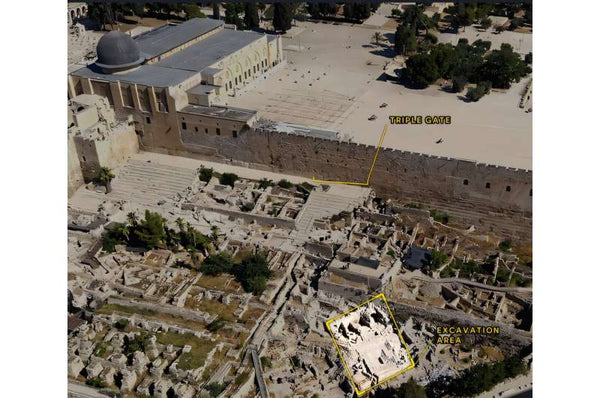
Editorial note: Gospel Noir distinguishes the physical artifact, the reading of its inscription, the proposed administrative interpretation and the unproven identity of its wearer. The licensed photographs above document Herodium and independently attested evidence for Pilate; none is presented as a photograph of the ring itself.
FILE UPDATED. CASE NOT CLOSED.
Continue the investigation.
Watch Gospel Noir case files, evidence shorts, and the Detective’s investigations, then explore the artifacts built from the archive.
10% off your first order.
Plus new Case Notes, Gospel Noir releases and store updates.