ARTIFACT / CLASSIFIED · Evidence reviewed October 19, 2026
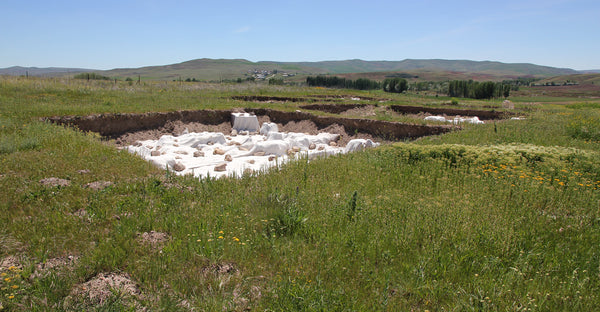
Cover: Djampa / Wikimedia Commons, CC BY-SA 4.0. A 2009 contextual photograph of the Lower Aqueduct, not the new excavation. Full attribution below.
CASE FILE: THE WATERLINE
A channel comes out of the ground. A name goes into the headline.
Jesus.
Before those two pieces are pinned together, we need to know what the excavation actually established.
Direct answer: Archaeologists announced a newly exposed 300-meter section of Jerusalem’s Lower Aqueduct near Ramat Rachel on October 11, 2026. The discovery concerns a water-supply system attributed to the Hasmonean period. It does not identify a particular person who drank its water. [Sources 1, 2]
The distinction matters. Evidence for the world described in a text is valuable. It is not automatically evidence for every person or event placed inside that world.

Evidence Item 01: What did archaeologists find?
The Israel Antiquities Authority describes a section south of Kibbutz Ramat Rachel, exposed ahead of planned residential construction. The system carried water through Solomon’s Pools toward Jerusalem’s Temple Mount. Excavation directors Benyamin Storchan and Gil Freid describe its original construction as probably belonging to the Hasmonean kings. [Sources 1]
That wording deserves to survive the trip from excavation announcement to social caption: probably, rather than an exact construction year assigned to every stone.
An aqueduct is infrastructure designed to carry water. This discovery is a newly exposed portion of a known system, not the first realization that ancient Jerusalem had a water supply.
Evidence Item 02: How did the water move?
According to the excavation account, the route extends roughly 21 kilometers from Solomon’s Pools to Jerusalem. Much of it descends only about one meter per kilometer. Gravity did the work; the engineering challenge was maintaining the gradient through the landscape. [Sources 1]
That is the part worth visualizing. A city’s water supply depended on a carefully controlled slope, not simply on building a large channel.
Imagine tracing a pencil line across an uneven desk while keeping it almost level. Now imagine that line must carry water across kilometers of terrain. The comparison is an illustration of the engineering problem, not a reconstruction of the builders’ methods.

Evidence Item 03: Does every visible feature date to Jesus’ lifetime?
No. The reporting describes multiple phases: an earlier plastered channel and ceramic pipes installed during the Ottoman period, about five centuries ago. The system remained in intermittent use until roughly a century ago. [Sources 2]
The photograph therefore needs a date as much as the headline does. A later repair can be evidence of the system’s long life without being a first-century feature.
For an investigator, this is a useful habit: ask which phase an object belongs to before attaching it to a biblical scene. The date of a system’s origin and the date of its last repair answer different questions.
Evidence Item 04: Did Jesus use this water?
October 18 coverage quotes scholar Douglas Estes expressing confidence that Jesus and his followers would have used water from the system during visits to Jerusalem. That is a historical inference. The same report acknowledges the absence of direct archaeological evidence linking particular people to the channel. [Sources 3]
The difference is between a plausible connection and an identified act.
A water system can establish how a city functioned. It cannot, by itself, tell us who filled a cup on a particular afternoon. No amount of emphasis in a headline supplies that missing identification.
Evidence Item 05: Why does this matter to readers of the Gospels?
Read John 7:37–39 alongside the investigation. The passage uses thirst and water in Jesus’ teaching. It is a textual and theological connection, not an excavation label identifying this particular channel.
The original value of the comparison is methodological. We can examine a physical water system, read an ancient text, and distinguish what each contributes. We do not have to make a stone channel prove a theological statement for the channel to be worth studying.
The headline audit
| Claim | Assessment |
|---|---|
| A section of Jerusalem’s Lower Aqueduct was exposed | Supported by the excavation announcement |
| The entire aqueduct has just been discovered | Misleading; this is a section of a known system |
| Every feature shown is from Jesus’ lifetime | Unsupported; the account includes later modifications |
| Jesus personally used this exact exposed section | Not established |
| The find independently proves a Gospel miracle | Not established |
What is new, and what is not?
- October 11, 2026: the excavation announcement was published.
- October 12: The Jerusalem Post updated its reporting.
- October 16: a mainstream headline linked the find to Jesus’ world.
- October 18: Aleteia published further coverage.
- October 19: this Case Note was prepared.
These are announcement and publication dates. They do not mean the channel was excavated in a single day or that each later article describes a separate discovery. [Sources 1–4]
The verdict
The useful finding is an exposed piece of Jerusalem’s infrastructure, with evidence of use and modification across time. The personal link to Jesus remains an inference.
For Gospel Noir, the case is a lesson in reading evidence at the right scale. A city has a water supply. A text places people in that city. The first fact can illuminate the second without identifying an individual user of the channel.
The waterline belongs in the file. The certainty belongs within the evidence.
File updated. Case not closed.
Frequently asked questions
Was the whole Lower Aqueduct discovered in 2026?
No. The announcement concerns a newly exposed section of a previously known system. [Sources 1]
Is this direct evidence that Jesus drank from it?
No. A personal connection is inferred from historical context, not demonstrated by an identified trace of Jesus. [Sources 3]
Why are there Ottoman pipes in an ancient aqueduct?
The system was modified and maintained over time. Later components should not be assigned the date of its original construction. [Sources 2]
Does this prove the Bible?
That question is broader than the evidence. The find helps investigate historical infrastructure; it does not independently establish every biblical event or theological claim.
Receipts: open the evidence locker
- Friends of the Israel Antiquities Authority: October 11 excavation announcement. Primary institutional account. Not a complete peer-reviewed excavation report.
- The Jerusalem Post: Lower Aqueduct excavation. Published October 11, updated October 12. Reporting substantially relies on the IAA announcement; it is not independent excavation verification.
- Aleteia: The aqueduct that fed the Temple Mount. October 18. Useful for tracing the Jesus-use interpretation and its limitation.
- New York Post: Jesus’ world headline. October 16. Included to document the headline’s circulation, rather than establish excavation details.
- Israel Ministry of Foreign Affairs announcement. October 11. Government publication of the excavation announcement.
Watch the excavation coverage
Open The Jerusalem Post’s report and accompanying excavation video, credited to Emil Aladjem / Israel Antiquities Authority. The current footage is hosted by the publisher; the photographs reproduced in this Case Note are the separately licensed contextual images identified above.
Continue investigating
Explore the same distinction between a physical setting and a specific event in Jesus Tomb Archaeology and the Magdala Stone and synagogue investigation.
If the investigation speaks to you, explore the Gospel Noir collection, including The Case Is Still Open and The Truth Can Handle Questions. These are merchandise links, not evidence sources.
10% off your first order.
Plus new Case Notes, Gospel Noir releases and store updates.